


Five novel technologies that may help diagnose and treat inflammatory bowel disease
Published: December 10, 2024
 Inflammatory bowel disease (IBD) research has come a long way in the last 20 years. One exciting development is the growing emphasis on precision medicine. This approach matches people with the best therapy based on their genetics, inflammatory biomarkers, and other unique biological and clinical characteristics.
“It is exciting to look at the emerging technologies that have the potential to make IBD care more convenient, less invasive, and more effective,” says Alan Moss, MD, chief scientific officer, Crohn’s & Colitis Foundation.
Let’s take a look at five new technologies that could transform the patient experience throughout their treatment journey.
- Next-generation capsule endoscopy models that allow for at-home endoscopic testing
- A robotic enteroscope that takes pictures inside the small intestine
- Wearable sensors that measure inflammatory markers in real time
- An ingestible smart pill that delivers targeted treatment
- Programmable polymers that promote tissue healing
The Foundation’s IBD Ventures program has partially funded the development of the last three innovations. This program’s goal is to financially support the early development of new products aimed at addressing pressing unmet medical needs of people living with IBD.
Next-generation capsule endoscopy
Doctors began using capsule endoscopy in 2001. Capsule endoscopy lets them see inside the digestive tract to enable a physician to visualize diseases of the small bowel and assess how well treatment is working.
Capsule endoscopy is a vitamin-sized capsule with a camera inside. Typically, patients swallow the pill, which travels through the digestive tract. They wear a sensor belt and data recorder, and the system transmits images from the capsule to the cloud. The capsule takes thousands of pictures in hard-to-reach places in the small intestine. It eventually passes through the patient’s stool.
 Recently, the Food and Drug Administration approved a new capsule endoscopy kit from Medtronic. Instead of a data recorder and sensor belt, patients wear a single-use smart wearable that adheres to a patient’s abdomen that collects data from the capsule. The kit makes the procedure more convenient for patients by allowing them to do endoscopic testing at home.
Robotic enteroscope eliminates the need for general anesthesia
Traditional endoscopy involves passing a long, flexible tube equipped with a video camera down the throat or through the rectum. Doctors may recommend traditional endoscopy to obtain more detailed images of tissue in the small intestine. For this procedure, patients must have general anesthesia and sometimes stay overnight at the hospital.
Researchers are developing a new robotic enteroscopy technology that would not require general anesthesia.
Robotic enteroscopy uses a flexible tube with a camera to examine intestinal tissue. It can travel effortlessly within the small intestine with the help of an external joystick, reducing the external force applied by the physician to navigate the endoscope and therefore minimizing a patient’s discomfort and potential damage to the intestinal wall.
Robotic enteroscopy is still in the research phase. One day, patients could use it in the outpatient setting.
Wearable sensors that measure inflammatory markers
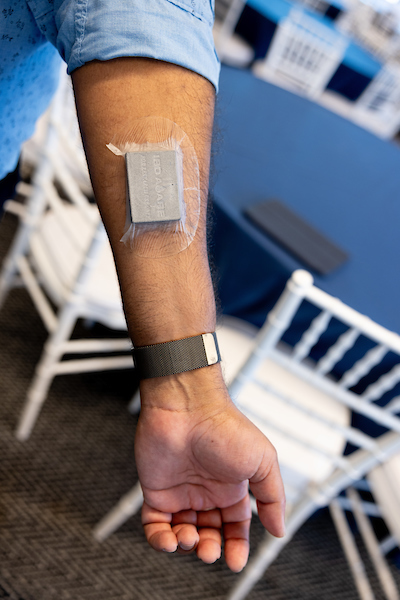 Researchers are also working on a wearable sensor to help people with IBD measure their inflammatory biomarkers in real time. The device may help users anticipate when a flare is about to occur—so they can take action.
The device measures inflammatory biomarkers by analyzing the sweat that forms on an IBD patient’s skin during typical daily activity. It sends the data to a smartphone app.
Research supported by the Foundation demonstrated that the technology accurately measures three biomarkers: TNF-a, IL-6, and C-reactive protein. Previously, only a blood test could measure these biomarkers of inflammation. The device also accurately measures calprotectin, which until now is only measured in stool samples.
Ongoing research aims to show that the sensor is effective when worn for longer periods in real-life settings.
An ingestible smart pill that delivers targeted treatment
Many IBD patients take oral medications to manage their IBD. Some of these drugs can cause unwanted systemic side effects.
A revolutionary new smart pill, now in development, is different. As the smart pill travels through the small intestine, it emits LED light and uses the reflections from surrounding tissue to pinpoint its location, allowing the device to release the drug where it’s needed most.
Researchers are testing the smart pill in healthy volunteers. The goal is to demonstrate that the drug delivery method increases drug levels in the colon while reducing overall drug exposure to other areas of the body.
Programmable polymers that promote tissue healing
One biotechnology company is developing a novel treatment for people with IBD. Specifically, the treatment uses polymers to target perianal disease, including anal fistulas. Anal fistulas are abnormal passageways that form from inside the anus to the skin outside the body. They can be debilitating for people with IBD.
The company bases this polymer technology on a combination of safe, naturally occurring compounds, such as glycerol. The compounds conform to and integrate with surrounding tissue, acting as scaffolding to allow natural healing of the fistula tract. They are also programmable—providers can adjust them based on the patient’s tissue-specific needs.
Programmable polymers have the potential to transform fistula treatment. The current gold standard for fistula care is a fistulectomy. This surgery, while sometimes necessary, can lead to chronic side effects such as fecal incontinence. The polymer offers a minimally invasive alternative for patients and supports healing while limiting trauma for a better long-term outcome.
What’s next?
IBD research is moving in many promising directions, from developing innovative technologies that improve patients’ daily lives to using artificial intelligence to gain deeper insights into the disease. People with IBD have more treatment options than ever before. We look forward to continuing to leverage technology to personalize patients’ treatment, improve their disease management, and enhance their quality of life.
To learn more about our research priorities and the groundbreaking work we’re supporting, visit the research section of the Foundation’s website.
Thank you to our supporter: