




Ally’s Law: Restroom Access & 20 Years of Advocacy
Published: August 6, 2025
Who is Ally Bain?
How Ally’s Experience with IBD Sparked a Movement
Diagnosed with Crohn’s disease at 11 years old, Ally Bain struggled for years to manage the symptoms of her inflammatory bowel disease (IBD). By the time she entered her teens, she had missed school, been in and out of the hospital, and would on occasion have to use the restroom up to 40 times a day.
When she was 14, Ally was out shopping with her mom when she had an urgent need to find a restroom, an experience that many people with IBD know all too well. The store she was in had no public restrooms, so she pleaded with the manager to let her use the employee-only facility. When he denied the request, Ally, who was doubled over in pain, had an accident. She remembers feeling ashamed and small.

Ally Bain stands in front of the US capitol building
Why Restroom Access Matters
For people living with IBD, restroom access is crucial. The disease can often cause a frequent and urgent need to use the bathroom at a moment’s notice.
Not knowing if or where a restroom is available can cause people with IBD to dramatically change their lifestyle due to urgency and fear of accidents. Restroom access can significantly impact a person’s ability to participate in daily activities like work, school, travel, and social events.
What Is Ally’s Law?
Wanting to spare others from her experience, Ally became an advocate and worked with her state legislature in Illinois to pass Ally’s Law in 2005.
Also known as the Restroom Access Act, Ally’s Law protects restroom access for people with IBD and other medical conditions. Though they vary by state, versions of Ally’s Law ensure access to employee-only restrooms when a public one is unavailable.
The law requires certain conditions be met, such as providing a document signed by a medical professional that confirms the diagnosis. The Crohn’s & Colitis Foundation offers free “I Can’t Wait” cards that are often accepted as proof.
Celebrating 20 Years of Ally’s Law
Not all disabilities are visible; Ally’s Law supports the dignity and independence of the millions of people with IBD and other medical conditions in this country. It affirms that IBD patients have the right to speak up, be heard, and use the restroom when they need it.
Progress, Challenges, and What’s Next
Thanks to grassroots advocacy, the Restroom Access Act has been enacted in 20 states.
Volunteer advocates from the Foundation have played a key role in helping to pass this legislation by sharing their stories, writing to their elected representatives, and meeting with officials during annual state advocacy sessions.
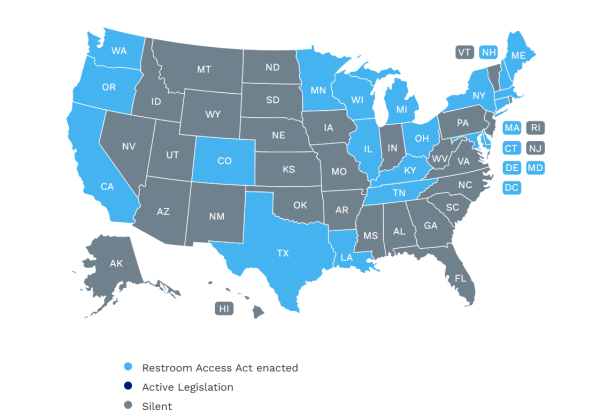
While tremendous progress has been made over the last 20 years, challenges remain.
The lack of publicly available restrooms in the U.S. is a serious public health crisis. The Foundation conducted a national survey on restroom access that found 72% of respondents who have experienced accidents in public believe they could have avoided the accident if there had been a nearby accessible restroom.
In states where restroom access laws have passed, patients and volunteers have been disappointed by the lack of awareness and compliance, as well as the absence of enforcement mechanisms for these laws.
The Foundation and its volunteers are continuing to fight for the right of everyone living with IBD to have access to a restroom when they need it most.
How to Advocate for Restroom Access
Ally once said, “A person’s voice as an advocate is the greatest instrument in speaking for millions of others.”
Becoming an advocate is one of the most important ways to have direct influence on restroom access and other issues that matter.
Contacting Legislators and Local Businesses
Take action with us and become an advocate. As an advocate, you’ll receive updates on IBD legislation across the country along with ways you can share your story, and opportunities to support the issues that matter to you. If your state hasn’t passed a restroom access law, use our restroom access toolkit to help pass legislation.
Even if your state has passed a restroom access law, we encourage our volunteers to work with their local city council or county commission to pass a local law that provides incentives to businesses who voluntarily open their restrooms.
Using the “I Can’t Wait” Card and We Can’t Wait App for Everyday Advocacy
To advocate for yourself, download the Foundation’s free “I Can’t Wait” card to present to businesses when you need to go.
You can also locate publicly accessible restrooms with the Foundation’s We Can’t Wait restroom finder app. It helps identify sympathetic establishments and allows users and businesses to add resources to continue building an ever-growing list of places to go.
Join Us
There are so many ways to get involved in the Open Restrooms Movement and the fight for accessibility. Ally’s Law may have started with one voice, but it continues with all of us.
About Laura D. Wingate, Foundation Chief Education, Support & Advocacy Officer
Laura Wingate began her career working at Memorial Sloan Kettering Cancer Center. During her tenure, she advised and implemented quality improvement initiatives, including redesigning the outpatient center to streamline the patient experience. Laura worked with pediatric and geriatric centers across the United States, providing professional entertainers through the Clown Care and Vaudeville Caravan programs, which expanded dramatically over her eight-year tenure.
Joining the Crohn’s & Colitis Foundation fulfilled Laura’s career aspirations and desire to make a difference for people with chronic illness. As the Chief Education, Support, & Advocacy Officer, Laura oversees patient and professional education, state and federal advocacy, and support programming for the Foundation. She is a graduate of the University of Rochester, School of Arts & Sciences, and holds certificates in Leadership & Management, Entrepreneurship & Innovation, and Strategy from Harvard Business School Online. She also earned a Reducing Racial Disparity in Health Care certificate from Harvard Online.