



Translating IBD Science into Hope: Reflections from a First-Time Congress Attendee
Published: February 13, 2026
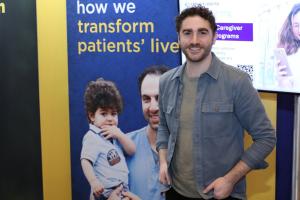
I’ve never participated in a conference—or in Las Vegas—and as someone who prefers quiet to chaos, I was surprised to find both delight and meaning at the 2026 Crohn’s & Colitis Congress. I’ve had Crohn’s disease for almost two decades, and after various medication changes, bowel obstructions, and surgeries, I found a deep gratitude in being surrounded by my people—my community, my fellow IBD patients, and the doctors and other clinicians who speak the same language. Each presentation and conversation reminded me why the science matters so deeply, translating complex data into something profoundly human—hope, progress, and connection. For once, I wasn’t just hearing about discoveries in IBD research; I was witnessing how they could shape my future and the futures of people like me.
From Scar Tissue to Solutions: The Next Chapter in Stricture Research
One exciting piece of information I learned was that there may be medication options coming for those of us who are prone to stricturing. A stricture is a narrowing of a portion of the intestine. This narrowing inflicted many hardships on me including numerous bowel obstructions, NG tubes, and ER visits throughout the years. My doctors told me, “This is a mechanical issue requiring a mechanical solution, surgery.” Dr. Florian Rieder, Director of the Program for Global Inflammatory Bowel Diseases at Cleveland Clinic, delivered a keynote on stricturing and explained that the discovery of specific bacteria may pave the way for medications that prevent stricturing and scarring in IBD patients.
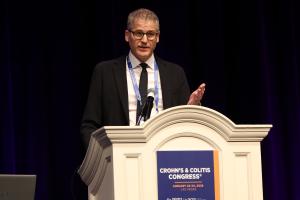
Dr. Florian Rieder delivering the Congress Keynote
I interviewed Dr. Alan Moss, a clinician-scientist and Chief Scientific Officer at the Crohn’s & Colitis Foundation, who explained, “For many years we’ve known that stricturing is scar tissue in the intestinal tract that causes narrowing and problems like obstruction or pain.” He and Dr. Rieder described how “bacteria migrating across the lining of the intestinal tract is one of the important triggers” of a fat called creeping fat, which surrounds the intestinal tract and contributes to this compression, and how these bacteria and creeping fat might be the key to treating strictures.
These new treatments may not only prevent future fibrosis, the scarring that causes intestinal narrowing, but could also reverse some existing narrowing. Moss noted that for people with very advanced fibrosis, medication may come too late to be effective, but for many others it could help them avoid surgery.
Insurance Barriers to Essential Medications
Healthcare costs and medication denials continue to be an ongoing issue for many of us. I currently take two medications for Crohn’s disease, and while my tests show that taking them together puts me into remission, one of the drugs is often denied because my insurance insists I only need one. Clinical pharmacist Melissa Kirkpatrick spoke at the conference about medication denials and emphasized to providers that when a medication is denied or a prior authorization is required, it delays healthy outcomes for patients. She gave examples like bridge programs, which offer short‑term access while insurance issues are resolved, and patient assistance programs, which can provide temporary access to medications when insurance denies coverage.
Kirkpatrick also detailed how providers can sometimes anticipate a denial, including when patients need two biologic drugs taken at once, are prescribed non–anti-TNF medications such as Entyvio (vedolizumab), or require dose escalation.
“It Rips the Life Out of Us”: Why Compassion Matters in Perianal Crohn’s Care
One presentation that really stood out to me was “The Psychosocial Impact of Perianal Crohn’s Disease: Strategies to Recognize and Optimize Resilience,” featuring patient advocate and Strategic Alliance for Intercultural Advocacy in GI (SAIA) CEO Tina Aswani-Omprakash and GI psychologist and Foundation Trustee Megan Riehl, PsyD.
It was empowering to see a patient and clinician appear onstage together, and they highlighted how crucial the clinician–patient relationship is. I’ve had providers who truly listen, are patient, and work with me—and others who rush, don’t leave room for questions, and seem apathetic.
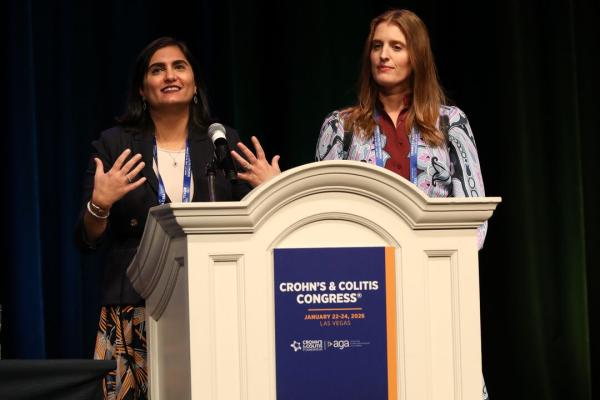
Tina Aswani-Omprakash and GI psychologist and Foundation Trustee Megan Riehl, PsyD
Aswani-Omprakash, who lives with perianal Crohn’s disease, described how deeply this condition can affect people, saying “it rips the life out of us,” and urged clinicians to always have empathy for patients and to be especially sensitive and kind when caring for those with perianal disease. Riehl emphasized that trauma‑informed care is not a checklist, but a way of practicing that centers lived experience and communication, and that it must be a true collaboration between patients and clinicians.
Serious IBD Science, Unlikely Zip Code
When you think of Las Vegas, it’s unlikely that IBD and doctors come to mind, but for a first-timer in Vegas and a first-time attendee at the 2026 Crohn’s & Colitis Congress, it turned out to be the perfect backdrop for serious science. The surreal sight of people gambling at 7 a.m., cigarette in hand, contrasted sharply with rooms full of clinicians, researchers, and patients focused on data, treatment advances, and improving the quality of life for patients like me. That tension made the experience even more powerful: cutting-edge IBD science was being translated into real-world hope, right in the middle of a city built on distraction. For me, it wasn’t just a great, community-building trip—it was a reminder that even in the most unexpected places, the science that shapes our care can feel personal, present, and deeply human.
Ian Goldstein is a Brooklyn-based writer and comedian, and a social media ambassador for the Crohn’s & Colitis Foundation.